Fort Whoop Up (1969) Accession No: P19738006000
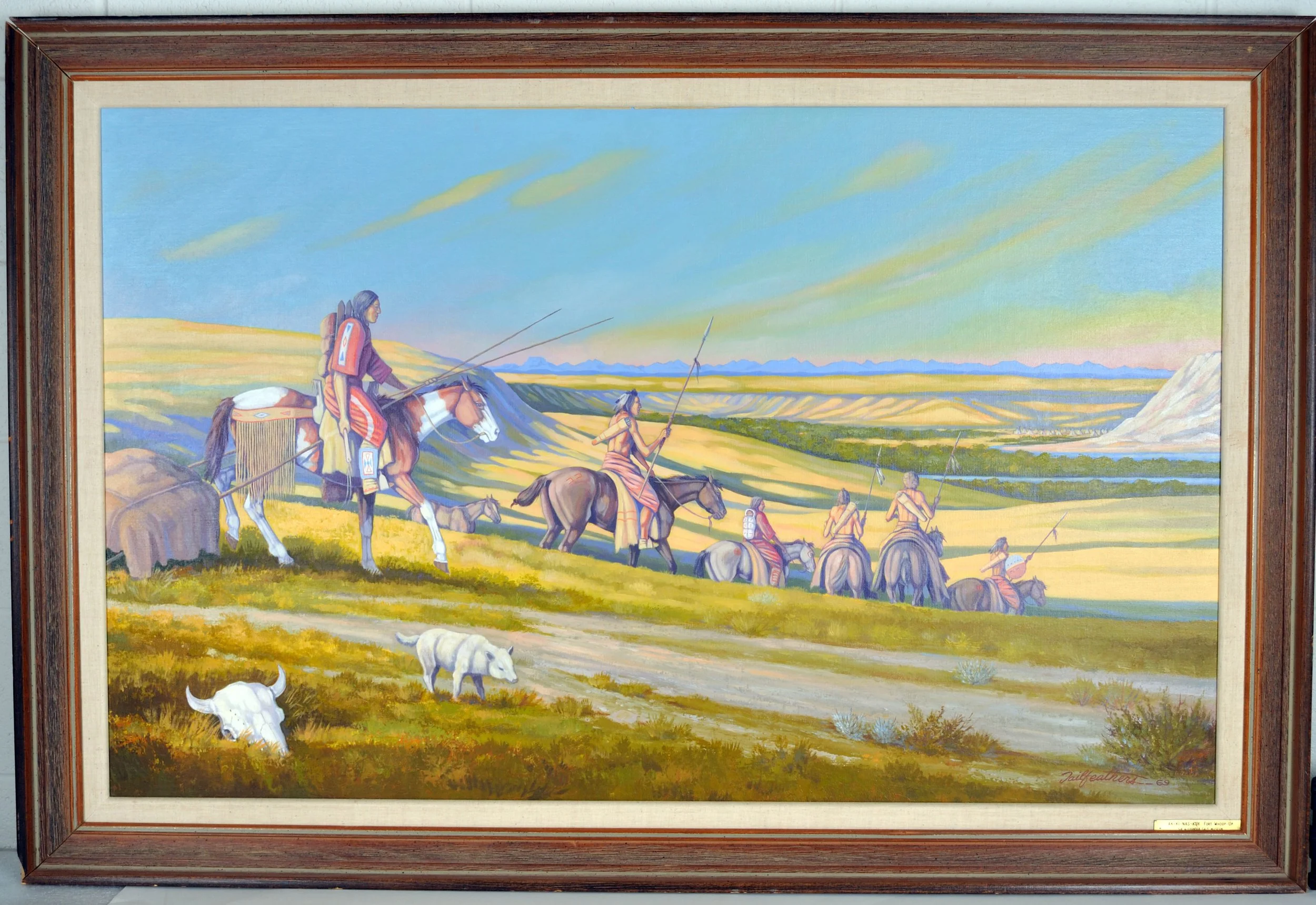
Fort Whoop Up (1969) Accession No: P19738006000
Oil. "Tailfeathers '69" (artist). The picture depicts an indigenous camp at the junction of the St. Mary's and Belly rivers and marks the site where Fort Whoop-up was eventually built.
Gerald Tailfeathers, born in February 1925 on the Kainai reserve in Standoff, Alberta, began formal art training remarkably early. At age ten, he studied at the St. Mary’s Lake Summer Art School in Montana, where he was influenced by artists such as Carl Linck and especially Winold Reiss, whose vibrant, romantic portraits of Blackfoot people shaped Tailfeathers’ early style. During this time, he also learned from Kainai elders, deepening his understanding of his own culture—an influence that would become central to his work.
In 1941, Tailfeathers earned a scholarship to the Banff School of Fine Arts, studying under Charles Comfort, Walter Phillips, and H.G. Glyde. Exposure to Western artists like Charles M. Russell and Frederick Remington encouraged him to experiment and refine his own visual voice. He later studied commercial design in Calgary and worked professionally for the Hudson’s Bay Company, while also serving on the Kainai band council. Throughout these years, he produced art in many media, including oils, watercolours, charcoal, pastels, and ink.
By the 1950s, Tailfeathers increasingly focused on Kainai history and culture, creating detailed visual vignettes of 19th‑century life. His reputation grew through the 1950s and 1960s, with exhibitions at the Montreal Expo (1967), the Calgary Stampede, the Glenbow Museum, and national shows across Canada. He continued to expand his artistic range, illustrating the award‑winning children’s book The White Calf (1965) and later producing cast bronze sculptures influenced by George Phippen.
Gerald Tailfeathers passed away on April 3, 1975, at the age of 50, leaving behind a significant legacy as a pioneering Kainai artist whose work blended technical skill, cultural knowledge, and historical storytelling. His uncle was Percy “Two Gun” Plain Woman, also a well-known Canadian Indigenous artist.
This painting can be used for language arts, art, or Indigenous history. It could be used as a visual prompt for a descriptive writing assignment or a short story. It could be used to prompt a discussion about painting, sparking reflection on depiction, composition, and expression. It could also be used to explore the contributions of our Blackfoot community.
Note: This is a Collections artifact, not an Archives item. Access is available only to the photograph, not the actual item.